By Hitesh Chhabra • Past Life Regression Expert & Psychologist
16 min read • August 2026
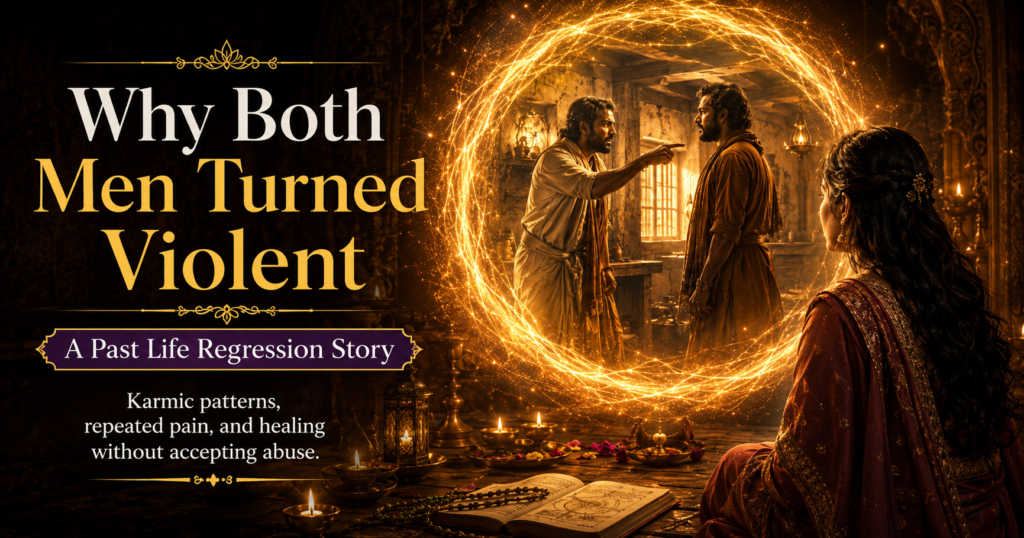
The Question That Brought Her to the PLR Session
Symbolic illustration inspired by the account; not historical evidence.
A young woman arrived for a Past Life Regression session, her heart heavy with a question that felt like a matter of life and death. She was at a crossroads, considering marriage to a man who had been her best friend for years. Her family approved, and on the surface, everything seemed right. Yet, she was terrified. She explained that ever since she had given her consent to the marriage, this man, the one who had been her loyal shadow for so long had begun to show a different face. He had started becoming violent.
During their arguments, his anger had begun erupting in frightening ways. More than once, in a fit of rage, his hand had come flying across her face in a slap. She was stunned, not only by the violence itself, but by the disbelief that the man who had stood beside her for years, the man she had trusted as her closest friend, could ever be the one to raise his hand against her.
She was initially cautioned that if a relationship had already become abusive before the wedding, she did not necessarily need a Past Life Regression to recognize the red flags. The shadows of this approaching marriage already seemed to conceal the demons of domestic violence, waiting to leave their signatures in bruises, scars and fear. It was almost as though something sinister was already lurking in the darkness beyond that wedding, hidden behind the curtains of her future home, watching with red eyes and waiting for the moment it could step out of the shadows and consume her happiness.
A Painful Pattern She Could Not Ignore
As the lady continued to explain her concerns, she revealed a deeper and even more troubling pattern. Years ago, when she was an 11th-grade student, a temporary teacher had joined her school. He was only five or six years older than her, and she felt a magnetic, inexplicable attraction towards him. Wanting to spend more time with him, she began taking private tuitions from him, perhaps imagining those hours as an opportunity for greater closeness with the person she had fallen for.
Instead, those private hours gradually became another source of pain.
Arguments and disagreements from their relationship began spilling into the tuition room. What could outwardly appear to be a teacher scolding a student for a mistake in her homework sometimes became an opportunity for him to take out the anger and frustration of their personal quarrels. He began hitting her, humiliating her and treating her increasingly like a target.
Soon, even school offered her no escape. He would single her out during class, ask difficult questions and humiliate her in front of the other students, allowing the bitterness of their private disagreements to seep into his role as her teacher. At times, their quarrels followed them outside the classroom as well. During one heated argument in the corridor, he grabbed her hand tightly and tried to pull her closer to him as she resisted. Other students happened to witness moments like these. What had begun as a private relationship was slowly becoming visible to the people around them, and whispers soon began travelling through the school.
Before long, her reputation was dragged through the mud. The relationship had trapped her on both sides: the man she loved was also her teacher, present in the classroom during the day and waiting again at tuition afterward. Her current fiancé had been sitting in that very classroom as her best friend, silently witnessing much of what she endured.
Years later, she now found herself haunted by an unsettling pattern: the two men she had loved most had both become sources of physical and emotional pain.
She needed to know why.
The Past Life Begins to Unfold
Symbolic illustration inspired by the account; not historical evidence.
As the regression began, the lady found herself transported away from the modern world and experienced herself as a wealthy male landowner in a rural village, roughly 45 to 50 years old. He had leased his land to others. As another scene emerged, he was seen walking towards his home, a large house built of mud. As he entered, a revolting sensation took over. A strong, unpleasant smell filled the house and would not go away.
He looked around and saw the floor littered with empty alcohol bottles. This man was a chronic alcoholic who had never married because of his addiction. The smell was not coming from the house alone. It seemed to have soaked into his clothes, his skin, almost every part of him. He himself was reeking, as though years of alcohol and neglect had become a stench his own body could no longer hide.
Then, amid what looked less like a home and more like a filthy pile of rubble, something unexpected came into view: there was a kitchen. And inside it, a woman was cooking food. The landowner was not married, so her presence immediately raised questions. Nearby, two children were playing in the middle of that same foul-smelling mess, almost as though this gutter-like place had somehow become their everyday surroundings. As the scene unfolded, the client understood that the woman in the kitchen was a poor villager who came there to cook and clean. Taking advantage of his wealth and her desperate poverty, the landowner had been physically and sexually exploiting her for years.
Eventually, the villagers discovered what had been happening to her. But in the twisted, deeply male-dominated society of that time, instead of standing beside a poverty-stricken woman who had been exploited for years by a wealthy alcoholic landowner, they turned their judgement upon her. The victim was branded as a woman of questionable character, while the man who had abused his power remained protected by his wealth and position. Cast out by society and left with two young children to raise, she had nowhere else to go. Poverty finally forced her back into that filthy, gutter-like house, compelling her to live under the same roof as the man who had exploited her in the first place.
The First Karmic Recognition
While still in a state of trance, the client was guided to look deeply into the woman’s eyes. The first recognition was startling, but what followed was far more powerful. That disgraced and exploited woman from the past life was recognized as the soul of the abusive teacher from the client’s present life.
Until this moment, the client had carried the painful memory of being humiliated, beaten and character-assassinated during the school years. But in the regression, an entirely different scale of suffering now stood before the client. The shame suffered in the present life suddenly seemed almost impossible to compare with the years of exploitation, poverty and social rejection that had been inflicted upon this soul in that earlier life.
While still in the trance state, the client’s perspective began to change completely. When the client had first come for the session, one of the biggest questions was, “How can I ever forgive someone who has hurt and humiliated me so much?” But now, after seeing what had happened in that past life, the same client began crying out again and again, “I have wronged you so much. Please forgive me. Please forgive me.”
The client herself was overwhelmed by remorse after seeing the magnitude of the other woman’s suffering. In that moment, the client felt that the pain endured at the hands of the teacher could hardly be compared with the years of exploitation, humiliation, poverty and rejection now unfolding before her in the past-life experience. Still in trance, the client kept asking that soul for forgiveness.
The question was no longer, “How can I forgive you?”
It had changed to, “Will you forgive me?”
But Where Was Her Fiancé?
But the story did not end there. The client started searching for the fiancé’s soul, and finally a scene of confrontation emerged. There was a man, the exploited woman’s husband, who arrived at the landowner’s house in a drunken rage. He had discovered what had been happening to his wife, but instead of seeing her as a woman who had been exploited for years, his wounded male ego chose to call it an affair. Her suffering did not become the centre of his anger; his humiliation did.
Once again, the woman carrying the pain was also made to carry the blame. In bitterness and rage, he told the landowner, “You keep her now; I don’t want her anymore,” and abandoned his wife right there.
When the client looked into the eyes of the exploited woman’s husband, another powerful recognition followed: he was the current fiancé. In that past life, he was the man who had been betrayed and humiliated by the landowner. Today, even though he had been a “best friend” for years, that old, subconscious pain of being “the man whose wife was taken” flared up the moment a formal commitment was made. Within the karmic pattern emerging through the regression, his sudden violent behaviour appeared to carry echoes of the unresolved anger and humiliation connected with that previous-life experience.
When the Karmic Roles Reversed
And so, the karmic picture seemed to become complete. The two souls who had suffered because of the landowner in that past life had both returned into the client’s present life as two different men. One was the woman who had been abused, exploited and disgraced. The other was her husband, who had carried the humiliation and helplessness of watching his family fall apart while feeling powerless to fight the wealthy man responsible.
In the client’s present life, the roles appeared to have reversed. Through these two souls, the client now found herself facing echoes of the same pain, humiliation and helplessness that had once been left behind in their lives. What had begun as two seemingly separate painful relationships was now revealing itself, within the regression, as one deeply connected karmic story.
But What About the Past Life Husband’s Karma?
At this point, another question may naturally arise.
If the exploited woman’s husband had abandoned her when she was already being exploited by the wealthy landowner and rejected by society, did he not create karma of his own? Should he not also experience the consequences of leaving his wife alone at the moment when she needed his support the most?
The answer is that a Past Life Regression allows us to explore the experiences connected with the person undergoing the regression. In this session, it was our client whose karmic connections were being explored. The teacher and the fiancé appeared because their souls were connected with the client’s story. We were not conducting regressions on those two individuals, so their complete karmic journeys, their other lifetimes, and the consequences of their own actions remain unknown to us.
It would therefore be incorrect to conclude that the husband simply suffered in the earlier life and returned only to give pain in the present one.
There is, however, an interesting possibility worth reflecting upon.
In that previous-life experience, the husband abandoned the woman after feeling betrayed and humiliated. In the client’s present life, the soul recognized as that husband became her closest friend and secretly loved her for years. Yet he had to watch the woman he loved become deeply involved with another man, the young teacher. He sat in the same classroom, witnessed their connection, remained beside her through its painful consequences, and carried his own feelings silently while her heart belonged elsewhere.
Could that emotional experience itself have been connected with his own unresolved karmic account?
Possibly.
Perhaps the soul that once walked away from his wife had now experienced, from another position, the pain of loving someone whose emotional world belonged to another man.
But this must remain a reflection, not a conclusion. We did not regress the fiancé, and therefore we cannot claim to know the complete karmic explanation of his life.
Karma is rarely a simple equation where one action produces one visible punishment and the account can then be declared closed. Every soul carries many relationships, choices and consequences across its journey.
A regression gives us a window into the karmic story relevant to the person sitting before us.
It does not give us the complete karmic balance sheet of every soul who appears in that story.
The Spiritual Way Forward: Healing the Karmic Account Without Accepting Abuse
Symbolic illustration inspired by the account; not historical evidence.
It was explained to the client that the purpose of Past Life Regression is not to burden a person with guilt after discovering something disturbing about a previous life. The purpose is to bring understanding, so that resentment can begin to loosen its grip and forgiveness can become possible.
Sometimes, after discovering a possible karmic connection, people may begin thinking, “If I caused this soul pain earlier, perhaps I must now stay and suffer until the account is settled.”
But that can become a dangerous interpretation of karma.
There is no reason to assume that an abusive person will somehow know exactly how much pain has to be returned and suddenly stop the moment some invisible balance has been reached. A person who has developed patterns of violence, humiliation or abuse may simply continue behaving in those ways. Waiting inside that suffering for the day when the karmic account will somehow become fully settled can create fresh wounds instead of healing old ones.
The purpose of understanding the past, therefore, should be very different.
If the regression brings forward a soul whom we may have hurt, we can acknowledge that pain, seek forgiveness and work towards restoring, at a spiritual level, what we believe was taken away.
For example, if someone’s dignity, peace, sense of purity or emotional strength was harmed through our actions, meditation can become a way of reconnecting with those very qualities within ourselves. Through meditation and a conscious connection with God Shiva, the soul can experience peace, purity, love and spiritual strength, and then consciously send those vibrations towards the souls with whom an unresolved account is felt.
This is where Kshama Yoga, the practice of forgiveness and seeking forgiveness, becomes important.
Instead of saying:
“I hurt you once, therefore you may continue hurting me now,”
the inner prayer becomes:
“Whatever pain may have been caused through me, knowingly or unknowingly, I acknowledge it. I seek your forgiveness. May you receive peace. May I also release this pain, and may this cycle end here.”
The two souls revealed in this regression deserved special attention because the connection had become visible. But spiritual healing need not stop with the people whose identities we know.
During meditation, we can also bring into our awareness the souls we may have wronged, even if we do not remember them individually. We can seek forgiveness from those whose pain we may never consciously know and send peaceful vibrations outward rather than remaining trapped only in the accounts that happen to become visible during a regression.
And this awareness can expand even further.
Human beings do not create consequences only through their relationships with other people. We also consume, damage and disturb nature and other living beings in countless ways, often without thinking about the suffering our actions may create.
Spiritual growth can therefore make us more compassionate, sensitive and conscious towards animals, other living beings and nature itself. It can develop Karuna Bhav, a deep sense of compassion, together with humility and harmony in the way we live.
The lesson of a regression should ultimately be:
Understand the past. Seek forgiveness where it is needed. Forgive where you are able. Heal what remains within you. And then move forward without creating another cycle of suffering.
A person has an entire present life still waiting to be lived. That life should not be surrendered to two or three painful relationships in the hope that suffering long enough will somehow settle an old account.
Spiritual understanding should make us freer, not more trapped.
An Important Note for Readers
A possible karmic explanation should never be used to justify abuse in the present life.
Violence is violence. Abuse is abuse. Exploitation is exploitation.
Whatever may emerge during a Past Life Regression, situations in the present must still be understood and dealt with according to the realities of the present. Personal safety, dignity, appropriate boundaries, professional support and necessary legal, medical or psychological help should never be abandoned because of a spiritual interpretation.
Past Life Regression experiences are subjective and are shared here as a means of spiritual reflection and personal understanding. Their purpose is not to tell a person that suffering must be tolerated because of something that may have happened in another lifetime.
The past may offer a perspective on why a painful pattern exists. It should never become a reason for allowing that pain to continue.
Tap each question to reveal a deeper perspective from this story and its wider life lessons.
Why discovering the past-life connection is only the first step, and not the complete solution?
Because insight become meaningful only when it changes how we respond in the present. Understanding a possible karmic background may bring clarity, but present-day choices, safety, boundaries, and self-awareness still matter.
Does forgiveness mean allowing harmful behaviour to continue?
No. Forgiveness can be an inner process of releasing resentment or emotional burden. It does not require accepting abuse, removing healthy boundaries, or remaining in a damaging situation.
What did the repeated pattern in the story suggest about unresolved pain?
It suggested that unresolved emotional patterns may continue to influence relationships and reactions until they are consciously understood and addressed. The value of recognizing a pattern is not merely to explain it, but to prevent its repetition.
Can a painful pattern be understood without being justified?
Yes. Understanding why something may have happened can create perspective, but it does not make harmful behaviour acceptable. Explanation and justification are not the same thing.
Why should a past-life explanation not be treated as a complete karmic verdict?
Because human relationships can involve many layers of choices, consequences, emotions, and experiences. A spiritual impression may offer one perspective, but it should not be forced into an absolute conclusion about the entire karmic account.
Should spiritual understanding ever make someone feel obligated to remain in suffering?
No. Spiritual understanding should create greater clarity, freedom, responsibility, and compassion. If an interpretation makes a person feel trapped in guilt, fear, helplessness, or continued suffering, that interpretation deserves to be questioned.
What changed when the focus shifted from only asking, 'Why is this happening to me?' to also asking, 'What do I need to understand?'
The perspective moved from simply identifying pain to exploring self-awareness and responsibility. This does not transfer blame for another person’s wrongdoing, but it can help reveal patterns, choices, or unresolved emotions that may need healing.
Can we seek forgiveness even when direct contact with someone is impossible or inappropriate?
Yes. Healing does not always require reconnecting with another person. Sincere acknowledgement, remorse, prayer, meditation, reflection, or other inner practices can become part of releasing guilt and resentment.
Why did present-day reality still matter even after a spiritual or karmic explanation emerged?
Because spirituality should never erase what is happening now. Violence remains violence, exploitation remains exploitation, and dignity, safety, boundaries, and appropriate support remain important regardless of any spiritual interpretation.
What is the real purpose of understanding the past?
The purpose is transformation, not fascination. The past becomes useful when understanding it helps us become more conscious, heal what remains unresolved, make wiser choices, and live the present with greater freedom.
Continue Your Journey
Need Personal Guidance?
Explore one-to-one Past Life Regression, healing and consultation sessions with the Vighnahartaa team.