
Perspectives & inner freedom
Beyond Past-Life Stories
A Conversation with Hitesh Chhabra on Inner Freedom
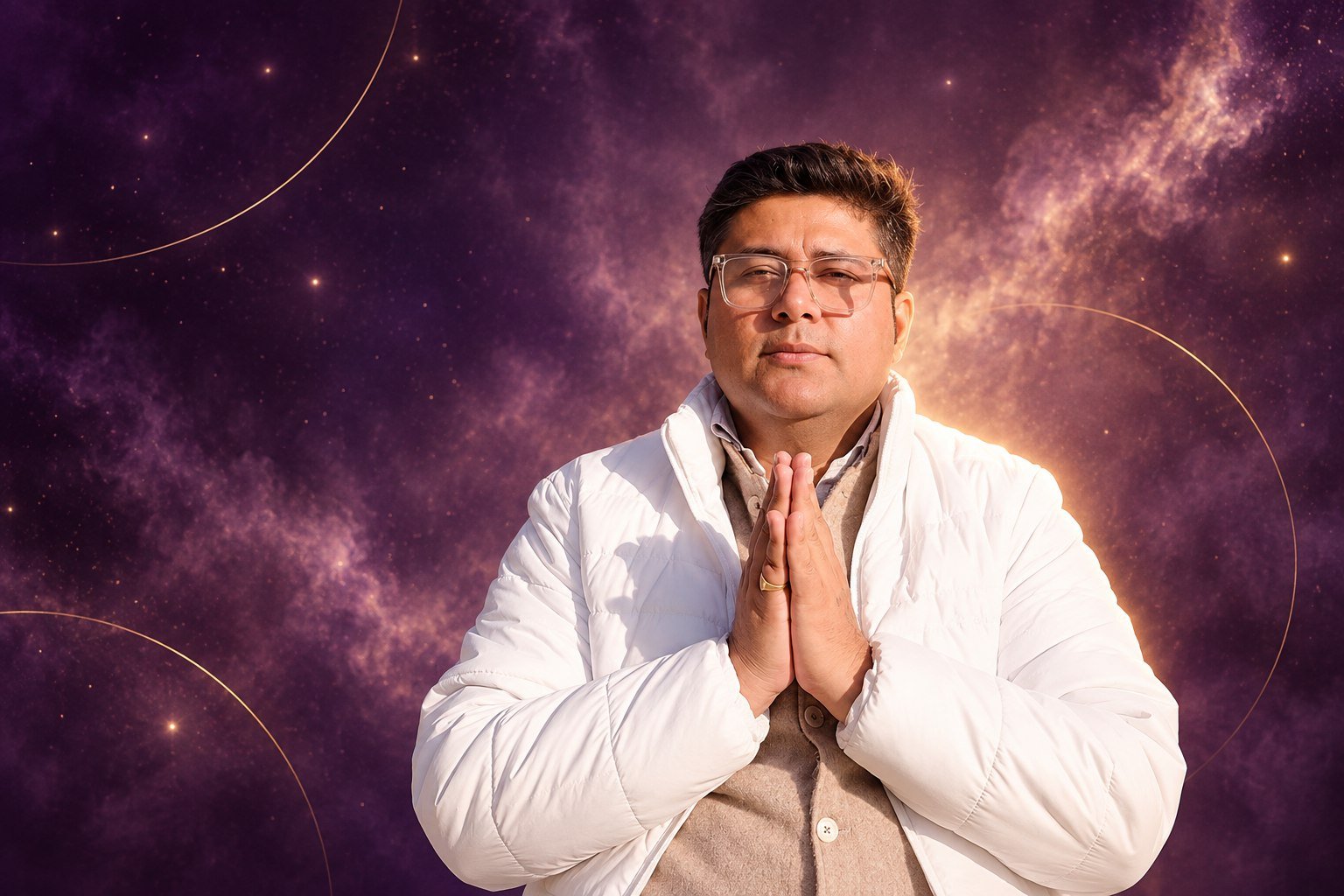
Not simply who we might have been.
What we choose to do with the life we have.
A conversation about past lives can begin with a palace, an unfamiliar face or a scene that seems to belong to another time. It is easy to remain there, absorbed in the story. But the person who came looking for help still has a present life to return to: a difficult relationship, an unsettling fear, a decision they cannot make, or a pattern they do not understand.
That is where my attention returns. What does this exploration mean for the person sitting before me? Does it offer a useful perspective? What needs care, what needs questioning, and what might they choose differently now?
At Vighnahartaa, the direction I want to encourage is simple: clarity, not curiosity alone. The purpose of looking into the past is to live the present more wisely.
A first-person reflection, not a transcript of an interview.
01 / The purpose of exploration
The person matters more than the story
Imagine someone trying to understand why the possibility of rejection feels unbearable. Before there is any discussion of another lifetime, there is already something important to listen to: what happens in their relationships, what they fear losing, and how they respond when they feel uncertain. This is an illustrative situation, not a claim about a particular client.
A striking scene would not remove the need to understand those realities. Nor would an unusual experience, by itself, tell us what the person should do about a relationship, a family conflict or an important decision.
This is why my work begins with a concern rather than a search for an extraordinary identity. I am interested in the issue that is affecting someone most deeply, not in collecting as many past life stories as possible. For one person, the question may concern attachment. For another, it may be resentment, guilt, fear or the difficulty of letting go.
My focus is not on alien identities, spectacular claims or the novelty of who someone might once have been. It is on what an experience brings into a meaningful conversation about the life they are living now. That focus does not require dismissing someone else’s beliefs. It requires being clear about the purpose of my own work.
An extraordinary story is not the same thing as an extraordinary change in how we live.
There is also room for uncertainty. An inner scene can feel vivid and deeply personal without being proof of a historical event. I believe it is important to distinguish the experience itself, the meaning someone gives it, and what can actually be established.
A useful conversation can hold those distinctions without becoming either dismissive or unquestioning. The listener does not have to accept every spiritual interpretation to reflect on a question about fear, attachment or responsibility.
02 / Lived experience
Before I studied psychology, life was asking difficult questions
I lost my mother when I was seven. My younger brother was only two. Responsibility arrived before I had the words to explain what I was feeling. Growing up meant learning to manage household duties, uncertainty and difficult circumstances while still trying to study and imagine a future.
There were dreams I could not follow in the form I first imagined. I loved science and wanted to pursue it, but I also had to consider the time, money and environment available to me. Later, I combined work with further study rather than waiting for ideal circumstances.
Those choices shaped a principle that remains central to the way I look at life: we do not control every circumstance that arrives, but we can keep asking what is possible with the resources, support and choices available to us.
That is not an instruction to deny pain or pretend that everyone has equal opportunities. Some situations are profoundly unfair. Sometimes the next meaningful step is to seek help. But a lost dream need not take away our ability to imagine another.
Learning to understand people
My professional life took me into sales, learning and development, communication and leadership training. I worked with people across India and international markets, learning how differently people respond to pressure, feedback, ambition and change.
Entrepreneurship brought another education: building operations, securing support, handling setbacks and facing serious financial pressure when a business did not work out. Formal study in psychology later gave structure to questions I had already been encountering through life and work. Meditation and spiritual exploration added another dimension.
These experiences do not mean that I know exactly how another person feels, or that surviving adversity alone qualifies someone to treat trauma. They mean I bring more than an abstract interest to conversations about uncertainty, rebuilding and self-respect. I know why advice must take account of the life in which a person has to use it.
03 / From understanding to action
Insight must return to the present

A session may end with a new way of understanding an old concern. But the next morning, the person still has a life to live. The conversation they have avoided may still be waiting. A boundary may still need to be expressed. A familiar reaction may still arise.
Understanding a pattern is not the same as changing it. The work afterward may involve reflection, regular practice, a different response, or help from an appropriate professional. Insight can be a beginning; it should not be sold as a promise that everything will now resolve itself.
In my own spiritual practice, connection with Supreme Soul Shiva is a source of reflection and strength. I want spiritual understanding to deepen responsibility, not replace it. A person should remain free to ask questions, to reflect on an interpretation and to decide what is meaningful to them.
The question I want to leave with someone is not only, “What did you see?” It is also, “What will you do with what you have understood?”
04 / The meaning of inner freedom
Freedom is not the absence of responsibility
One of the most important distinctions in my work concerns painful relationships. A spiritual explanation should never become a reason to excuse violence, humiliation or control. Whatever someone believes about a karmic connection, harmful behaviour still needs to be addressed in the present.
Forgiveness does not require continued access to you. Seeking peace does not require abandoning boundaries. Understanding another person’s pain does not make you responsible for accepting their harmful actions. Personal safety and appropriate professional support must remain part of the conversation.
Responsibility also does not mean blaming yourself for everything that has happened. There is a difference between asking what you can influence now and declaring that you deserved the suffering you experienced. I do not want spiritual language to blur that distinction.
Freedom is not one-sided. To receive freedom, we must also learn to give freedom.
That principle turns the question inward as well. We may want relief from other people’s expectations while holding tightly to our own expectations of them. We may ask to be understood while leaving little room for another person to think, choose or grow differently.
For me, inner freedom includes noticing those contradictions. It is the willingness to examine our own reactions without surrendering our dignity. It allows love without ownership, reflection without endless self-condemnation, and a change of direction without deciding that life is over.
I do not see my role as giving people all the answers. My work is to help them explore more deeply. A guide should encourage a person’s capacity to question and choose, rather than make that person increasingly dependent on the guide.
This is the larger vision I hold for Vighnahartaa: a place to explore psychology, spirituality and human experience in ways that encourage clearer thinking and more conscious living. Not followers. Freer thinkers.
05 / For listeners and podcast hosts
A conversation worth having
A podcast offers room to stay with a difficult question. A story can open the door; a thoughtful conversation can examine its meaning, its limits, and its relevance to ordinary life.
I welcome conversations connecting spiritual exploration with relationships, work and everyday choices. They can begin with past life regression, but they do not have to end there.
Beyond the story
What should a past-life exploration help someone understand, and what should we avoid claiming?
Love, karma and boundaries
Can we explore a spiritual connection without making suffering an obligation?
Rebuilding when plans change
How do we respond when the life we imagined is no longer the life available to us?
A guide, not a guru
What does spiritual growth look like when the aim is independent thinking rather than dependence?
You do not need to share my beliefs to join this conversation. I welcome disagreement and careful questions. My contribution is a perspective shaped by lived experience, professional learning and spiritual practice, not a request for unquestioning acceptance.
Podcast & interview enquiries
Let’s have a thoughtful conversation.
For a thoughtful conversation with Hitesh Chhabra in Hindi or English, share your podcast, audience and proposed subject with the Vighnahartaa team.
Scope: Spiritual reflection and self-exploration, not a substitute for medical or psychological care. Regression experiences are subjective; no historical verification or outcome is promised. See the website disclaimer.