
Vighnahartaa Journal / Podcast conversations
From Childhood Loss to Leadership: Hitesh Chhabra on Rebuilding Life with What You Have
A life does not need a perfect beginning to contain meaningful possibilities.

A personal reflection
Before there was a career, there was responsibility
When people meet someone as a trainer, a speaker or a spiritual guide, they see the person who can now stand in front of a room and speak. They do not necessarily see the child who first had to learn how to get through a day.
My name is Hitesh Chhabra. My life story did not begin with a carefully planned path toward leadership. I lost my mother when I was seven. My younger brother was two. With that loss came responsibilities that I was too young to have chosen and could not simply put aside.
School existed alongside cooking, household work and concern for my brother. Childhood was not only a place for dreams; it was also a place where practical needs demanded attention. I learned early that a difficult situation does not wait for us to feel ready.
I do not tell this story to turn pain into a credential or ask anyone to admire suffering. I tell it because it shaped a question that still guides my work: when life does not give us what we hoped for, what can we build with what remains available?
01 / Seeing the whole person
Growing up quickly is not the same as having no needs
A child who takes responsibility may look capable from the outside. That does not mean the child stops needing care. Being able to cook a meal, manage a task or look after someone else is not the same as feeling safe, supported and free to be young.
This distinction matters to me when I listen to adults speak about their earlier lives. A person can function, achieve and appear confident while still carrying questions about belonging or worth. Their competence should not become a reason to overlook their pain.
My own experiences help me listen with sensitivity, but they do not mean I know exactly how another person feels. Nor does having survived hardship automatically qualify someone to treat every kind of psychological difficulty. Lived experience can deepen empathy; it must still sit alongside learning, humility and respect for the limits of one’s role.
A meaningful podcast can explore that tension without turning it into a competition over who suffered more. The question is not whether another person’s childhood was worse than mine. It is what their experience meant to them and what support they need now.
02 / Practical hope
Changing a dream did not mean abandoning my future
I loved science at school and wanted to become a scientist. I did well in the subject. But choosing a stream was not only a question of interest or ability. It was also a question of time, money, responsibilities and the environment in which I would have to study.
I chose commerce. Later, the cost and time involved in chartered accountancy raised another difficult question. Who would support that path while the rest of life continued? I chose to work and continue studying through an open-learning route.
Those decisions could be told as a list of dreams I gave up. I see something else in them: attempts to remain engaged with the future rather than freeze in front of a door that was not opening.
That does not mean I believe everyone should lower their ambitions or accept unfair circumstances. Sometimes we should persist. Sometimes we should seek help or challenge a barrier. But sometimes we also need the freedom to redesign the route without treating the change as proof that we have failed.
Hope, for me, was not a promise that one particular plan had to work. It was the willingness to believe that another worthwhile plan could still exist.
We do not control everything life places before us. We can keep asking what is possible with what we have.
03 / Learning to help others learn
The distance between a school desk and a training room
I came from a government-school environment where spoken English was not a strong part of everyday learning. Later, working in call centres placed communication at the centre of my professional life. I had to learn, adapt and keep developing.
By my early twenties, my work had moved into learning and development. Sales, collections, operational training, behaviour and leadership became part of the professional world I worked in. I also worked across international contexts, including projects connected with the United Kingdom and India.
There is something powerful about discovering that a skill you once lacked can become a skill you use to help others. But a trainer’s job is not simply to demonstrate competence. It is to understand why another person has not yet understood, and to find a way of making the learning usable.
That experience still shapes the way I speak. I look for an example that brings an idea into focus. I pay attention to the difference between a person nodding at an explanation and actually being able to apply it. A room can applaud an inspiring sentence and still leave without knowing what to do differently.
This is why I value podcast conversations that make room for practical detail. What did adapting look like? What had to be learned? What belief became less useful? Where did support make a difference? Those questions give an audience something more durable than a polished success story.
04 / When achievement is not the ending
Building a business also taught me about losing one
Entrepreneurship brought another education. I worked on building a payment-acquiring business, securing initial funding and developing operations across multiple Indian states. It required processes, people, decisions and the willingness to begin before everything felt certain.
It also brought setbacks. Funding ran out. Financial pressure and the experience of rebuilding challenged the idea that professional progress should always move in one direction.
I would not want a listener to hear this and conclude that a positive attitude makes practical problems disappear. It does not create money by itself, erase obligations or undo a difficult decision. Recovery can require information, specialist advice, time and help from other people.
What attitude can influence is whether we remain able to look at the next possible step. When identity becomes tied completely to a business or a position, a setback can feel like the loss of the entire self. Yet a person is more than one venture, even when the consequences of that venture are serious.
The question I return to is not ‘How do I pretend this did not hurt?’ It is ‘What do I understand now, and what can I responsibly do with that understanding?’
05 / Meaning without denial
Spirituality added a perspective, not an escape route
My later study of psychology and my exploration of spirituality gave more structure and language to questions life had already placed before me. They did not remove the need to deal with practical reality.
For me, spirituality becomes useful when it helps us examine our reactions, our expectations and our relationship with what we cannot control. It becomes less useful when it asks us to deny pain or wait passively for life to change on our behalf.
Personal responsibility also needs compassion. A child does not choose the circumstances of their childhood. People facing hardship do not all have the same resources or freedom. Saying ‘work with what you have’ should invite an honest assessment of possibilities, not blame someone for what they lack.
Sometimes what we have includes another person’s willingness to help. Sometimes the responsible step is to ask for support, not prove that we can manage alone. Rebuilding is not less meaningful because it is shared.
For podcast hosts
A conversation about resilience without the slogans
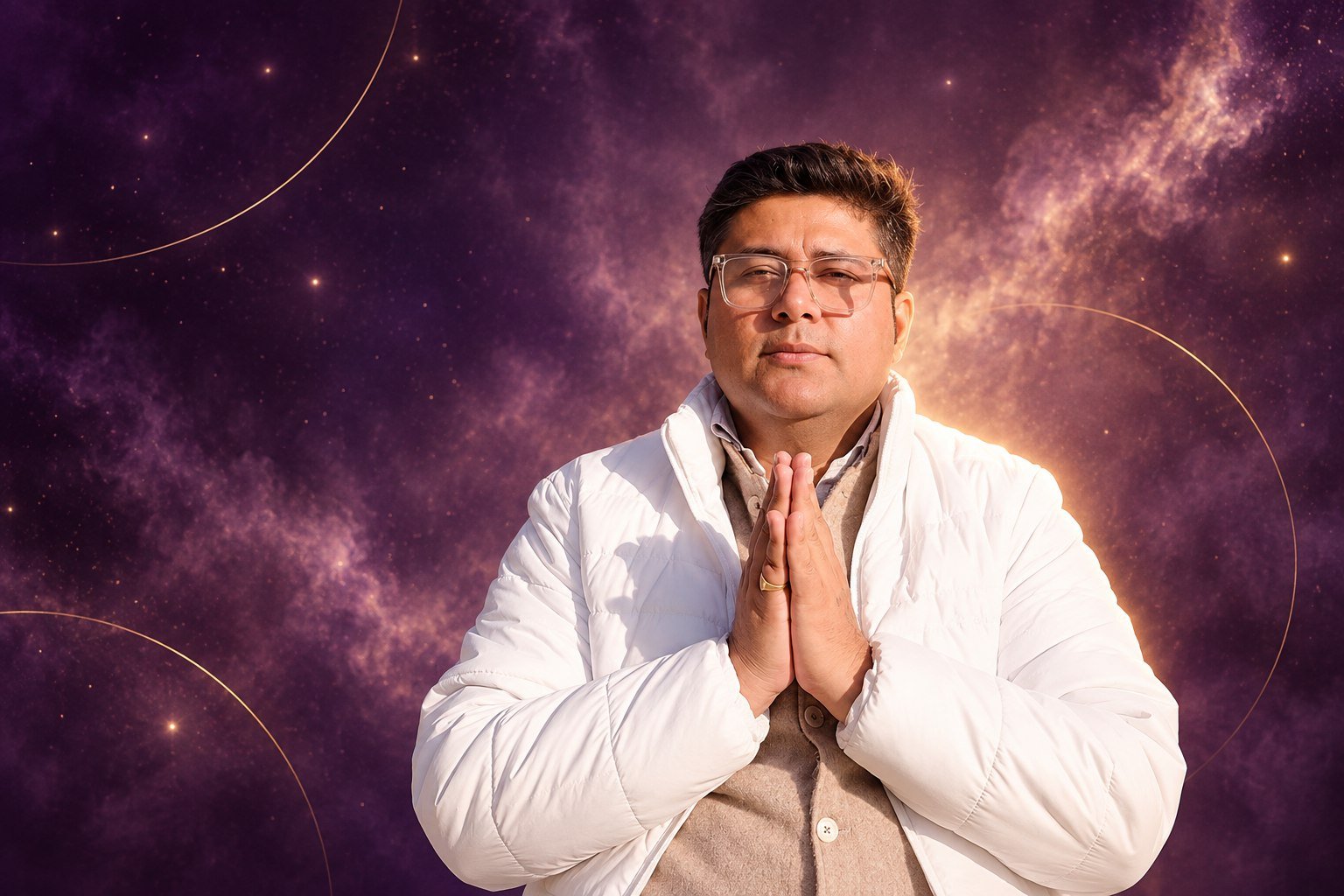
For podcast hosts, my life story offers a route into grief, ambition, adaptable goals, communication, leadership and the experience of beginning again. We can discuss how early responsibility shaped me without suggesting that suffering was necessary or that success cancels grief.
I bring an orator’s ease with storytelling, a presenter’s clarity and a specialist leadership trainer’s attention to what an audience can apply. I am comfortable connecting personal experience with the choices people face at work, in families and during periods of uncertainty.
An episode might begin with childhood loss, follow the decisions that changed my educational path, explore the transition into training and entrepreneurship, and end with a grounded question: how do we build a meaningful life when the original plan is no longer available?
I welcome invitations in Hindi or English. The purpose is not to present myself as someone who has mastered every difficulty. It is to offer a candid conversation in which listeners can recognise that changing direction need not mean giving up on themselves.
Podcast invitations / Hindi & English
Invite Hitesh Chhabra to your podcast
For podcast invitations, email me directly or send my team a WhatsApp message. Please share your podcast name or link, audience, proposed topic, preferred language and recording format.
Send your podcast invitation by email.
WhatsApp messages only. No calls.
This is a first-person reflection on Hitesh Chhabra’s own experiences, not a prescription for how others should grieve or recover. Personal stories do not replace individual psychological, medical, legal or financial support. Read the website disclaimer.