
REAL PAST LIFE STORY
By Hitesh Chhabra • Past Life Regression Expert & Psychologist
Approx. 12 min read • October 2026

The marriage was over. The questions were not. Within a few years of entering her husband’s home, the woman had found herself outside that relationship, carrying the bewilderment of something that had broken without ever becoming what she had hoped it would be. When she came for past life regression after divorce, she was not merely curious about another lifetime. She wanted to understand why closeness had become so difficult, and why the people between her and her husband seemed to have occupied more space than the marriage itself.
Her account began with her husband’s childhood. He had lost his parents when he was young. His elder brother and sister-in-law had raised him, and his gratitude toward them was not a small obligation that could simply be put aside. In them, he saw the mother and father he no longer had. Leaving them was something he did not want to consider at any cost.
For his wife, however, that same household had felt unwelcoming. She described friction with the sister-in-law from the beginning, followed by incidents she understood as attempts to create distance between the couple. As the interference grew, the relationship became increasingly difficult to sustain. She did not describe an abusive relationship between herself and her husband. What hurt was that their marriage could not find enough room to breathe within the larger family relationship. Eventually, they separated.
There was another uncertainty she had carried for much longer. Since childhood, she said, she had sometimes felt the presence of souls without bodies. Some dreams had seemed to show events before they happened. When she spoke about these experiences at home, her parents became concerned. She reported having been taken to a psychiatrist and diagnosed with bipolar disorder. Alongside her questions about marriage, she wanted to explore the meaning she attached to these childhood experiences.
The divorce had left her deeply sad for months. Then another man entered her life, and a romantic relationship began. That brought a new question into the room: was there something older behind this feeling of connection too? She was looking backward while standing at the threshold of a possible new beginning.
These were the threads she brought to the session: a broken marriage, a family bond she could not find her place within, unusual experiences from childhood, and the hope and uncertainty of loving again. The exploration would not begin with any of the faces she expected. It began with a tree.
As she entered the regression, a vast tree emerged. Its foliage was dense, its shade broad enough to seem like a world of its own. Beneath it sat a man in saffron clothes, a mala in his hand. Before there was an explanation, there was this simple arrangement: the sheltering tree, the seated figure, and the steady absorption of someone accustomed to spending long periods in practice.
Hitesh asked her to look more closely. Was this man merely visiting? Had he stopped there for a while, or was the tree part of the life he lived every day? The details began to settle. This was not a stranger passing through. He was an ascetic, and the place was familiar to him. The woman began to experience the scene as a life of her own.
His days moved between a temple and the tree. At the temple, he worshipped Durga Maa. When the temple rituals were over, he returned to sit beneath the branches, carrying the image of the goddess into his meditation. Devotion had become the centre around which the rest of his existence turned.
But a life so withdrawn still had a history. When Hitesh asked about family, she sensed that the man had one, yet no longer maintained contact. He had left that world behind. Some personal blow had driven him away from household life, and spiritual practice had become his refuge. The wound itself was not yet visible.
That missing piece changed the feeling of the scene. The saffron clothes did not simply stand for peace. Behind the stillness was someone who had been hurt, someone who had turned away from ordinary relationships without necessarily understanding everything that had happened within them. The story would return to that hurt later. First, another person approached the tree.
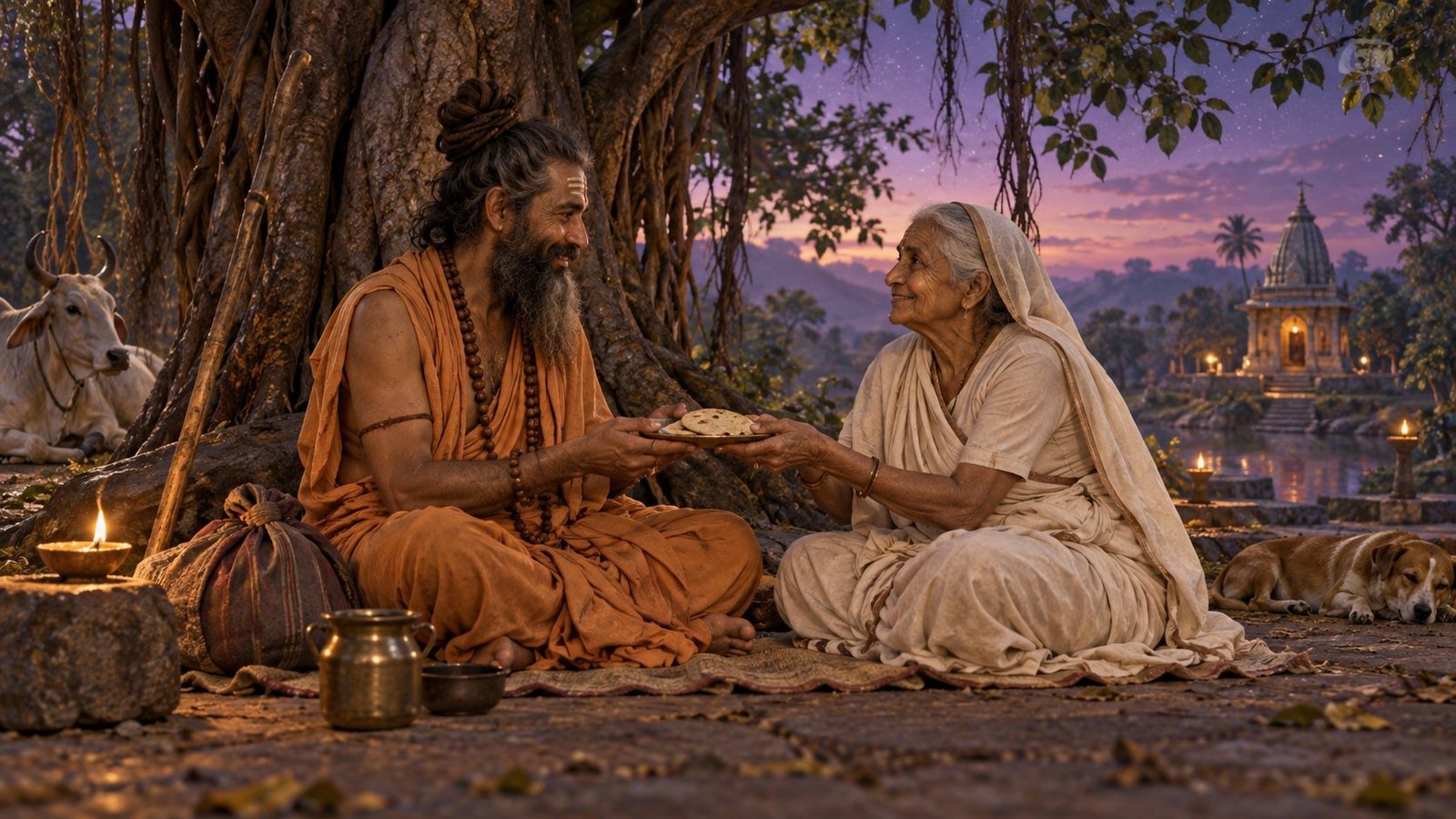
She was an elderly woman carrying food for him. She was not his birth mother, yet there was a mother’s concern in the regularity of her visits. While the ascetic had withdrawn from the demands of a household, this woman had quietly made his meal part of her own responsibility. She brought him roti and stayed with him for a while.
Nothing grand announced her importance. She was not arriving to celebrate his reputation or to witness an extraordinary display. At this point in the story, her care was ordinary and dependable. Someone had thought of him. Someone had remembered that, however absorbed he might be in spiritual practice, he still needed to eat.
Her visits also gave her space to speak. There were difficulties in her home. Her children caused her distress, and family life felt unsettled. She asked the ascetic what she should do. He listened and included her household in his practice, turning his attention toward it during meditation. The client described him offering the spiritual strength he received from his deity for the peace of the woman who fed him.
It was a small circle of exchange: food and affection in one direction, attention and prayer in the other. Before the later complications, this relationship carried a tenderness that did not need a formal name. She treated him as her son, and he tried to respond to her kindness.
Hitesh asked the client to look into the elderly woman’s eyes and notice whether she recognised her. Slowly, a present-life relationship came into focus. The woman who had brought roti was the mother who had given birth to her in this life. A connection that had first appeared beneath a tree now reached into the home of her childhood.
In the narration, Hitesh considered the older woman’s wish for a son like this ascetic as one possible spiritual thread in their later relationship. What mattered emotionally was not a complicated chart of lifetimes. It was the strength of a bond formed through repeated acts of care, and the pain that would follow when that care began to go unnoticed.
The scene did not change all at once. According to the client, the elderly woman’s family difficulties eased through the ascetic’s spiritual intervention. Word spread. People began to come to him with troubles of their own, and the quiet place beneath the tree became a place where others sought answers.
The man who had once lived largely within his own practice was now surrounded by expectation. Others looked to him as someone with unusual abilities, someone who might put right what they could not. Their growing attention began to change the way he saw himself. The client described pride entering gradually as his reputation increased.
The elderly woman still came. The food had not become less nourishing, and the care behind it had not become less sincere. Yet its importance had diminished in his eyes. His attention belonged increasingly to the many people who wanted something from him, rather than to the person who had once given something without needing him to be famous.
This is the quiet ache in that part of the account. Nothing required a dramatic rejection. A relationship can begin to hurt through repeated inattention. The motherly woman felt the distance grow, while the ascetic, absorbed in his expanding spiritual identity, failed to give that distance the weight it deserved.
Hitesh connected this scene with a possible spiritual pattern in the present mother-daughter relationship: a fear of losing someone once more to a life of spiritual withdrawal. This was the interpretation explored in the session. Beneath it lay a familiar human question. When a person we love moves into a world we do not fully understand, how much of our response comes from care, and how much from the fear of being left behind?
For the ascetic, the central difficulty was not that people respected him. It was that admiration had started to crowd out gratitude. The story was moving from devotion toward a more uncomfortable examination of how he used the influence he had acquired.

Later scenes showed him worshipping Kali Maa as well. Hitesh makes a distinction in the narration: the form of the goddess being worshipped was not the problem. The question was what the practitioner did with the abilities he believed he had received. Devotion and the responsible use of power were not automatically the same thing.
A family came to him for protection. They said a deceased person’s soul was troubling them. There had been a dispute, possibly involving property, and a man had died. The family’s own part in that death was not fully explained when they sought help. What they placed before the ascetic was their present fear and their desire to be free of the soul’s influence.
He turned his attention toward the soul. Another side of the story emerged: harm, a death, and a family left struggling after its member was gone. The soul was angry and unwilling to leave the people it held responsible. To the ascetic, however, the fact that someone had come to him seeking shelter carried an obligation. He saw protection as his duty.
He used his power to separate the soul from that household and keep it bound with him. This was not a passing restraint in the account. Years seemed to pass. The soul remained captive, and its appeals continued. It wanted him to understand that its family had been brought to ruin, that its life had been taken, and that now even its anger had been placed under someone else’s control.
The emotional pressure in the scene comes from those two positions held against each other. The ascetic believed he was fulfilling a responsibility. The captive soul experienced another injustice. One saw himself as a protector; the other could not understand why protection for those who had harmed it required its own prolonged captivity.
This was where certainty became dangerous. Once the ascetic had decided what his duty meant, he no longer seemed able to make enough room for the suffering that complicated his decision. The wish to help had narrowed into the conviction that he was entitled to decide how another being should remain bound. Recognising that injustice does not make revenge the answer; it makes listening and discernment indispensable.
Then the client recognised the captive soul. It was the man who had become her husband in this life, the husband from whom she was now divorced. The recognition brought the story back to the question that had led her into the session. Within the experience, confinement, resentment and separation were no longer isolated scenes.
The exploration also touched on the present sister-in-law. The client associated her with the bereaved family left behind after the man’s death, not with a clear direct encounter between herself and that woman in the earlier lifetime. The exact family relationships were not fully mapped. Hitesh’s narration leaves this as an incomplete connection, while the larger emotional pattern was the harm that can follow when helping one side means refusing to hear another.
There was still the question of her present partner, the man who had entered her life after the divorce. To explore that connection, the session moved behind the scenes already seen, to the time before the ascetic had chosen saffron clothes and a life beneath the tree.
He had once had a close friend. The friendship carried enough trust for the two to begin a business together. This had been a life involving work, money, plans and reliance on another person, not only temples and meditation. The ascetic’s earlier world now began to take shape.
As the business started earning, he discovered that the friend had betrayed him over money. The injury was deeper than a failed arrangement. Trust had been placed in someone close, and the person relied upon had become the source of the hurt. That betrayal, the client felt, was what had driven him away from household life and toward renunciation.
The opening scene could now be seen differently. The man beneath the tree had not simply arrived at detachment through peaceful understanding. He had also carried disappointment into his withdrawal. Spiritual practice had become the path he chose after a wound in an ordinary human relationship.
She recognised that former friend as the man with whom she was now romantically involved. The source does not tell us what decision she made afterward. Hitesh explicitly says that they did not discuss how she later assessed the present relationship. The account ends with the recognition, not with an invented breakup, reunion or promise about the future.
A session that began with questions about divorce had unfolded through several forms of relationship: the family that raised a husband, the motherly woman who fed an ascetic, the people who sought protection, the soul that remained unheard, and the friend whose betrayal preceded renunciation. Each connection brought a different question about care, freedom and responsibility.
The most useful question is not simply who was whom. It is what we do when a relationship places something difficult before us. Can gratitude coexist with healthy boundaries? Can helping remain compassionate when another person’s account unsettles our certainty? Can spiritual practice help us understand a wound instead of only carrying us away from the place where it happened?
For someone rebuilding after separation, reflection should make the present more spacious, not more frightening. A painful marriage is not a verdict on a person’s worth. The possibility of a spiritual pattern does not mean someone must accept mistreatment. Nor does a recognition in a session replace the need to notice how people actually behave today.
The story offers no tidy scene in which every conflict is resolved. Its value is in the mirror it holds up: an apparently spiritual life can still contain pride; a desire to protect can still silence another; and a humble act of care can deserve more attention than public admiration. Understanding becomes meaningful when it changes the way we listen, choose and treat one another now.
This article is adapted from Hitesh Chhabra’s narrated session account. Atmospheric descriptions are literary expansions, not additional verified memories or verbatim client quotations. Regression experiences and perceived soul connections are subjective; they do not establish historical facts, justify accusations or diagnose illness. Bipolar disorder needs appropriate professional assessment and care. Do not change or stop prescribed treatment based on a regression. The account does not prove supernatural abilities or a karmic cause for divorce. No post-session outcome is claimed.

Past Life Regression Expert
& Psychologist
Helping people explore recurring emotional, relationship & life patterns through Past Life Regression, healing and spiritual guidance.
Open each reflection to explore the story’s lessons and the choices they invite in everyday life.
The elderly woman’s roti mattered before the ascetic became well known. Later, the care remained the same, but his attention changed. This is a useful test in our own lives: do we still make time for those who supported us before success, status or a wider audience arrived? Gratitude becomes real through the attention we continue to give.
The ascetic was deeply engaged in worship, yet the story still shows pride and mistakes. A spiritual routine should not become a certificate that every decision we make is right. Its value includes the willingness to notice when we have become impatient, dismissive or too attached to our own importance.
The family seeking protection placed its suffering before the ascetic, but the captive soul had a history of harm too. In family disputes, leadership and everyday advice, the person who reaches us first may not hold the whole picture. Compassion needs patient listening, especially when additional details make the situation less comfortable.
The ascetic’s protective intention became a reason to keep another being restrained. The practical lesson is to examine the effect of our help, not only the intention behind it. Advice, influence or authority should create room for responsible choices, rather than making another person dependent on our decisions.
The husband’s bond with the people who raised him was emotionally important. The marriage also needed its own space. Gratitude toward family does not have to mean unlimited interference, and asking for boundaries need not mean rejecting those who cared for us. These conversations deserve clarity before resentment fills the silence.
The earlier betrayal helps explain why the man withdrew into renunciation. A new environment, role or spiritual practice can offer support, but it does not automatically settle the hurt we bring into it. Asking what still feels unresolved can be more useful than assuming that leaving a situation has healed everything it contained.
The motherly bond in the account also carried the pain of growing distance. In present relationships, concern and fear can become tangled. We can listen to a loved one’s worry without surrendering every choice, and express our independence without treating their attachment with contempt. Understanding the feeling beneath a reaction may soften a difficult conversation.
The captive soul’s suffering was central to the scene. Recognising that suffering does not make retaliation the only possible response. In ordinary life, a more constructive path can involve safety, boundaries, appropriate accountability and support. Listening to hurt and endorsing every action taken from hurt are two different things.
The recognition of the current partner is not followed by a reported decision in the video. That open ending matters. A relationship today should be evaluated through honesty, consistency, respect and communication today. Reflection can raise questions worth discussing, but it should not turn an unverified past-life identity into a verdict against someone.
The strongest invitation in this story is not to become absorbed in a list of karmic identities. It is to become more attentive to gratitude, influence and the freedom of others. One meaningful next step could be listening more carefully, restoring a neglected connection or setting a clear boundary. A useful insight changes how we live, not only what we believe.
Explore one-to-one Past Life Regression, healing and consultation sessions with the Vighnahartaa team.
Learn meditation free of cost and receive spiritual guidance to develop greater peace, inner strength and a deeper connection with God.

Past Life Regression Expert & Psychologist
We help people explore recurring emotional, relationship and life patterns through Past Life Regression, healing and spiritual guidance.
You May Also Like
Watch Hitesh Chhabra’s original session narration on YouTube. The source video is in Hindi.