
Vighnahartaa Journal / Podcast conversations
What Spiritual Podcasts Should Ask About Past Life Regression
The most useful question is not only what someone saw. It is what we can responsibly make of it.

A better starting point
What happens after the extraordinary story?
A microphone is switched on. A host leans forward. The guest begins describing a scene that emerged during a past-life regression. There is a different place, another identity, perhaps a relationship that feels strangely familiar. It is easy to see why an audience would keep listening.
But a past life regression podcast has a choice at that moment. It can move directly to the next astonishing detail, or it can pause and ask a more demanding question: what does this experience mean for the person living their life today?
That second question is where I prefer to begin. I am Hitesh Chhabra, founder of Vighnahartaa. My work brings together a background in psychology, learning and development, leadership training and spiritual exploration. I welcome podcast conversations that give these subjects room to breathe without requiring the audience to abandon its judgment.
For hosts preparing an interview, the questions below offer a route beyond spectacle. They make space for curiosity, but also for uncertainty, responsibility and the ordinary human concerns that often sit underneath an extraordinary account.
Question 01
Why did this person seek exploration in the first place?
Before asking who someone believes they were, ask what brought them to the session. Was there a recurring relationship difficulty, a persistent fear, a sense of guilt or a question they could not stop returning to?
The distinction matters. A vivid story can become so absorbing that the original concern disappears from the conversation. Yet a person usually returns home to the same relationships, responsibilities and decisions. Those realities deserve as much attention as the experience itself.
A host might ask me: ‘How do you help someone identify their main concern when they arrive with ten different problems?’ That opens a useful discussion about listening, setting expectations and keeping the exploration connected to the present. It also avoids assuming that every problem has a past-life explanation.
Question 02
What is the difference between an experience and evidence?
An experience can feel deeply meaningful without establishing that every scene is a factual record. A person may report images, emotions, bodily impressions or a strong sense of recognition. The intensity of those impressions does not, on its own, verify a previous life.
This is an important question for a serious past life regression podcast: ‘How do you distinguish what a participant describes, how you interpret it and what can actually be independently checked?’ Those are three different layers. They should not be presented as interchangeable.
Research on clinical hypnosis for particular health concerns is also not evidence for reincarnation. The National Center for Complementary and Integrative Health describes hypnosis research in specific clinical contexts; that should not be stretched into validation of every claim made under the word hypnosis. A useful interview can respect spiritual belief while keeping this boundary visible.
I would rather have an honest conversation that includes ‘we do not know’ than offer certainty the experience cannot support. Listeners should not have to choose between being curious and thinking critically.
The purpose of looking into the past is to live the present more wisely.
Question 03
What happens in a session and what may not happen?
Hosts often ask about the most dramatic session. I would also invite them to ask about an ordinary session, a slow session and a session in which no clear imagery emerges. That gives listeners a more balanced understanding of the process.
In our regular individual PLR format, the overall appointment is usually three to three-and-a-half hours. It includes an initial conversation, a short break, the guided exploration and time to return and reflect. It is a time-based process, not a promise that a fixed number of concerns will be resolved.
Some participants describe several experiences; others explore one theme slowly. Some do not experience what they expected. Lack of imagery should not be turned into a judgment about their spiritual worth, nor should anyone feel pressure to produce a story.
Another useful question is: ‘How is a participant’s own experience different from a practitioner’s proxy interpretation?’ These are not the same process. A practitioner describing impressions on someone’s behalf is offering an interpretation, not giving the client a firsthand memory or independently verified information.
Question 04
How do you avoid putting answers into someone’s mouth?
The wording of a question matters. ‘What, if anything, do you notice?’ leaves a different amount of room from ‘Who hurt you in that life?’ The second formulation assumes both a past-life event and a person responsible for harm before the participant has described either.
Hypnosis does not turn memory into a recording device. A responsible interview should address suggestion, uncertainty and the possibility of inaccurate recollections. No listener should be encouraged to accuse a real person, abandon treatment or make a major decision solely because of an image or interpretation from a session.
There are questions about consent too. What does the participant understand before beginning? Can they pause or stop? How is privacy protected if a case is discussed publicly? What happens if someone becomes distressed or needs support beyond the practitioner’s scope?
These subjects may be less sensational than a royal identity or an unusual scene. They are also essential to understanding how a practice treats the person who has placed trust in it.
Question 05
What changes when the session is over?
Imagine someone leaves an exploration saying, ‘I recognised how tightly I hold on to people.’ The next conversation should not end at the recognition. How does that insight affect the way they speak to a partner? Can they notice a controlling impulse before acting on it? What practical support might help?
These are illustrative questions, not a claim that one session produces a particular outcome. Experiences and outcomes vary. Insight can be a beginning, but it is not a substitute for the work of changing a habit, repairing harm or seeking appropriate care.
For me, the strongest follow-up question is: ‘What responsibility does this understanding invite in the present?’ Spiritual language becomes less useful when it explains everything but changes nothing. It becomes more useful when it helps a person observe their choices with greater honesty.
For podcast hosts
The conversation I can bring to your show
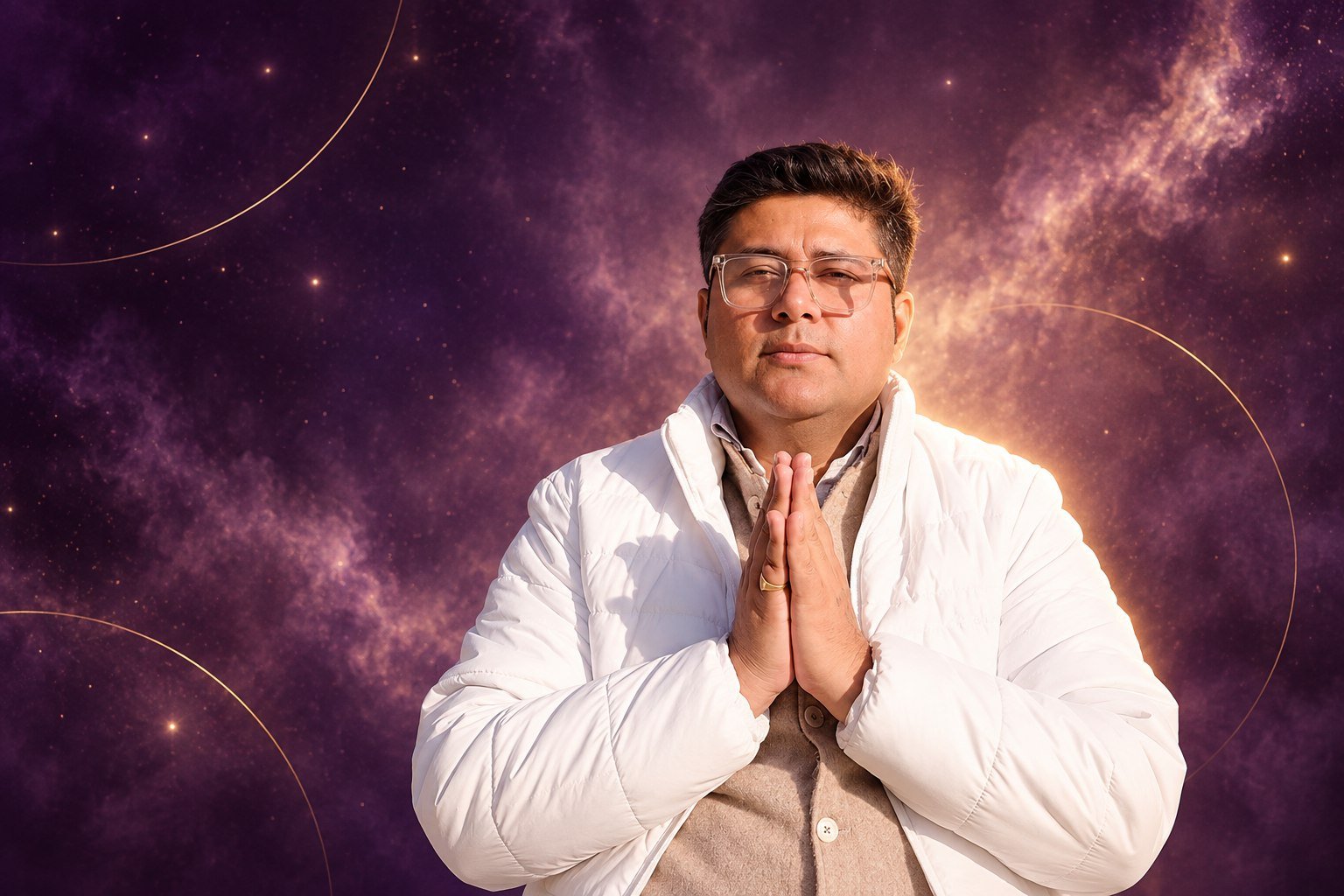
I am available for past life regression podcast interviews in Hindi or English. I bring the communication skills of an orator and presenter, the structure of a specialist leadership trainer and a perspective shaped by personal loss, professional growth and rebuilding after setbacks.
That combination allows us to move between a participant’s account, the questions it raises and the everyday behaviours an audience recognises. We can discuss karma without using it to blame people, spiritual curiosity without overstating evidence, and inner freedom without suggesting that another person should surrender their independence to a guide.
You do not need to agree with every spiritual interpretation to have a worthwhile conversation with me. Thoughtful disagreement, careful follow-up questions and a willingness to leave some questions open can make an episode more valuable, not less.
A possible episode arc is simple: why people seek PLR; what the process involves; where experience and evidence differ; what ethical safeguards matter; and how any insight might translate into a more conscious present life. The aim is an audience that leaves with better questions—not merely a more dramatic story.
Podcast invitations / Hindi & English
Invite Hitesh Chhabra to your podcast
For podcast invitations, email me directly or send my team a WhatsApp message. Please share your podcast name or link, audience, proposed topic, preferred language and recording format.
EMAIL HITESH DIRECTLYhitesh@vighnahartaa.com
Send your podcast invitation by email.
WHATSAPP THE TEAM+91 95180 81745
WhatsApp messages only. No calls.
This article discusses spiritual exploration and interview practice. Past-life impressions are subjective and are not verified memories, diagnoses or proof of reincarnation. PLR is not a replacement for appropriate medical or mental-health care. Read the website disclaimer.
Further reading on hypnosis and its limits