Reflections
Rudraksha Is Not Fashion.. It Is a Need — And Anyone, From Any Religion, Can Wear It.
By Hitesh Chhabra • 29 May 2026 • 7 min read
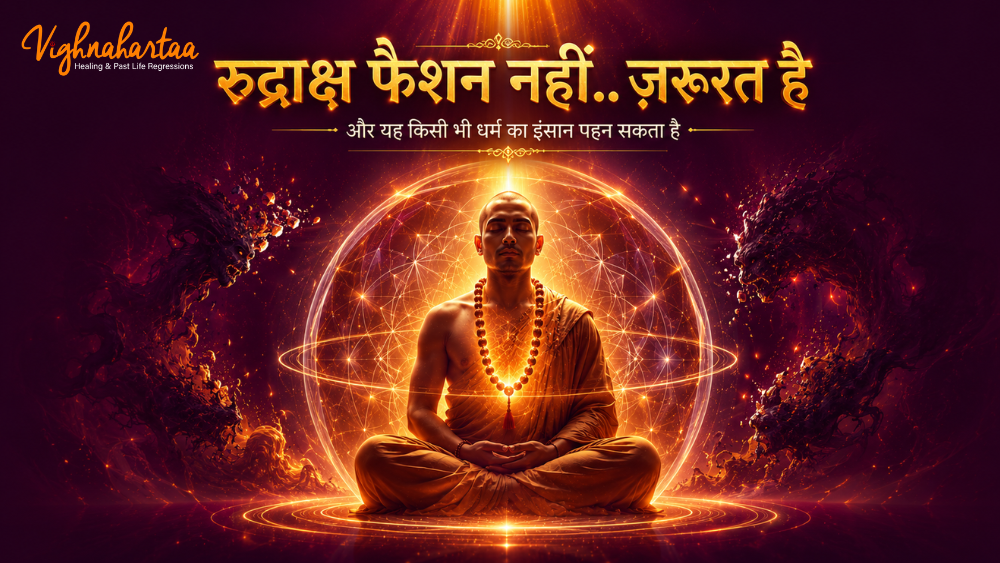
Rudraksha Is Not Fashion.. It Is a Need — And Anyone, From Any Religion, Can Wear It.
There were three questions. All three completely genuine.
First — "Brother, you used to have hair before. Why do you keep your head shaved now?" Second — "Why have you started wearing so many Rudraksha malas? You never used to wear any." And third — "Brother, I am associated with a particular organisation, or my religion is not Hindu — can I also wear Rudraksha?"
The answer to all three questions is connected by a single thread. And that thread is — need. Not fashion, not identity — only and only need.
Why Was the Hair Shaved? — A Practical Method of Releasing Burden
In the work of past life regression and spiritual counselling, one thing is certain. The person who comes in front of you is surrounded by negative energy. In 70 to 75 percent of cases, some form of negative force — whether the influence of troubled spirits or the effect of black magic — is present around that person.
And when you serve someone who is unwell — whether sick in body or in energy — some part of their negativity comes to you as well. This is the reality of any healer's life. Reiki healers, PLR therapists, astrologers — all experience this.
The topmost part of the body is the head. And it has been personally experienced that when hair and beard grow, a strange heaviness begins to set in — a mild sadness, a draining of energy. And when the hair is shaved — a lightness arrives. As if some burden was resting on the head and has now been lifted.
This is not superstition. This is the practical experience of a sadhak (spiritual practitioner). When the work is such that carrying others' burdens becomes unavoidable — then means to release those burdens must also be practised. Shaving the head is one of those means.
The Rudraksha Malas — Not a Display of Sadhana, But a Tool of Necessity
There is a common assumption — that a sadhak who wears many malas has reached a very high spiritual level. But the truth is the exact opposite.
When sadhana is complete — when the depth of meditation is such that the soul itself can absorb every attack and incinerate every negativity — then no external tool is needed. A mala is worn when sadhana is insufficient.
Right now the work is such — every second or third day cases come in where one person carries four spirits, another carries ten, another hundreds. To help liberate spirits in such large numbers — the energy required for this cannot come from meditation alone. The body's prana energy is also consumed. Breathing becomes laboured.
So the Rudraksha mala is an amplifier. Just as a microphone amplifies the voice, this mala amplifies the divine energy of the sadhak. The connection that needs to be established with those souls — becomes stronger.
This is not a matter of pride — it is an honest acknowledgement. "My sadhana is not yet that strong. The work is large. So I need assistance." And this assistance comes — through Rudraksha.
Three Types of Rudraksha — Three Different Purposes
The 108-bead mala of Panchmukhi (five-faced) Rudraksha — this is connected to the five elements. Earth, fire, air, water, and ether — it purifies the energy of all five. Whenever negative energy exerts its influence, it disturbs and imbalances the elements of the body, causing illness. This mala corrects that imbalance. It is especially useful for those who do spiritual service — Reiki healers, PLR therapists, astrologers.
Ekmukhi (one-faced) Rudraksha — this is for those who are being attacked by negative spirits. Sudden anger, fear at night, incoherence in speech — these are the third-stage symptoms of a spirit's presence. Ekmukhi Rudraksha is very powerful. When an attack occurs, it absorbs the attack upon itself. Wearing it in a silver chain keeps its energy cooler — it calms anger.
Dwimukhi (two-faced) Rudraksha — this balances yin and yang energies. For those in a female body with an excess of masculine energy, or those in a male body with predominantly feminine tendencies — this mala brings both energies into equilibrium.
Can a Person of Any Religion Wear Rudraksha?
This is a very important question. And its answer is equally simple.
If you are connecting Rudraksha to your religious identity — "I am Hindu so I will wear it" or "I am associated with an organisation so I will need permission" — then this question must be asked of the elders of your religion. That is their authority, not ours.
But if you are viewing Rudraksha as a tool — like a medicine that resolves a specific problem — then the question of religion does not arise at all.
Take an example. A soldier in the army — Hindu, Muslim, Sikh, Christian — all wear a bulletproof vest. Because that vest protects them from bullets. Does anyone ask before wearing it, "Is this permitted in my religion?" No. Because this is not a matter of religion — this is a matter of need.
A soldier going into a jungle wears high boots to protect against snakes and thorns. They too don't ask about religion. They look at the need.
In the same way — if you are being attacked by negative spirits and your sadhana is not sufficient to withstand it — then Ekmukhi Rudraksha is a shield. This shield is not your identity — it is your protection.
Do Wear It — But Keep These Things in Mind
Do not make Rudraksha into fashion. Wearing it and posting on social media to show "look how spiritual I am" — this weakens its power. And it also sends the wrong message to the people around you.
Wear Rudraksha only when there is a specific purpose — a problem that needs to be resolved, a service to be done that requires extra energy. When the purpose is fulfilled — you can let it go naturally.
And if you are buying one, purchase it with a certificate. It is available online as well as at local religious stores. But an inexpensive Rudraksha without certification is difficult to verify for authenticity. Pay a little more and get a certified one.
Similarly — a salt lamp at home absorbs negativity. A fragrant environment. Incense, lamps, aroma oils. These are all tools. They too are not the property of any religion — they are gifts of nature.
What Is the Ideal — and What Is the Reality
The ideal is that a sadhak's spiritual state be so elevated that no external tool is needed. The divine knowledge we have received tells us — meditate for 8 hours, do Amritvela (pre-dawn meditation), be consistent — if all of this were fully followed, there would be no need for the mala.
But the reality is — the work is large and the energy is limited. And when the work is large and the means are few — then whatever appropriate assistance is available must be taken.
Becoming dependent on the mala is also a challenge. Because then the work gets done even with less sadhana, and the mind starts leaning that way. So one must avoid increasing dependence on tools. Strengthening the power of sadhana is the ultimate goal.
Rudraksha Is Not Fashion.. It Is a Need — And Anyone, From Any Religion, Can Wear It.
When medicine is needed — the doctor does not ask which religion you belong to. Medicine works because the body needs it.
Rudraksha is the same. It is medicine for the soul. A shield for energy. A companion in sadhana.
Wear it — but looking at the need. Wear it — not for identity, but for purpose. And when the purpose is fulfilled — return to sadhana. Because ultimately, what liberates from all bondage, what lifts every burden — is the remembrance of God. Not any mala.
Written by Hitesh Chhabra
A calm guide for past life regression, spiritual healing, and inner clarity through Vighnahartaa.
Talk on WhatsApp →